
Short answer: A college incubator earns from co-working seats and cabins rented to outside startups and freelancers, paid training and certification, consultancy and services for startups and local MSMEs, events and sponsorships, lab and equipment use, and small equity or fee arrangements with the startups it supports. State rules matter: recognised incubators in Uttar Pradesh must give their own startups free incubation for up to two years, so seat income has to come from other users.
Why income matters from Year 1
Grants build an incubator, but they arrive in instalments, depend on calls opening, and end. A campus centre that earns some income from its first year is easier to keep running, easier to fund, and better at proving its value to the board. Income also builds the track record that later grants and CSR partners look for.
Seven income streams for a campus incubator
| Stream | Who pays | Notes |
|---|---|---|
| Co-working seats and cabins | Outside startups, freelancers, local businesses | The most dependable stream. Price per seat depends on your city |
| Training and certification | Students, faculty, working professionals | Short courses in entrepreneurship, product, design, IPR, AI tools |
| Consultancy and services | Startups and local MSMEs | Business plans, compliance help, testing, market access |
| Events and sponsorships | Companies, banks, industry bodies | Hackathons, summits and demo days attract sponsors |
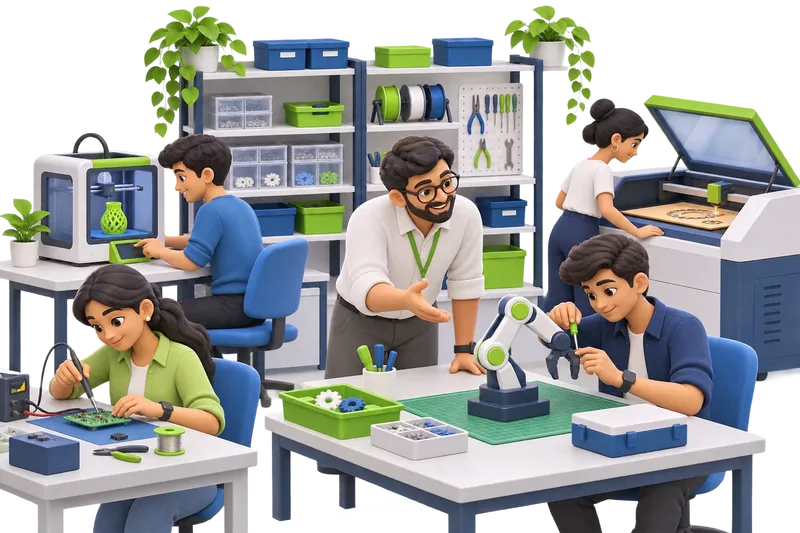
| Lab and equipment use | Startups, MSMEs, other colleges | Prototyping, 3D printing and testing by the hour |
| Equity, fees or revenue share | Incubated startups | Small stakes or success fees, applied to the incubator's objects |
| Programme management for others | Government missions, CSR partners, corporates | Running funded programmes such as accelerators or EIR cohorts once eligible |
The rules that shape income
- Free incubation rules. Uttar Pradesh requires StartinUP-recognised incubators to give their startups free incubation for up to two years. So in UP, seat income must come from outside users such as freelancers, MSMEs and visiting startups, not from your own incubated startups.
- Not-for-profit status. A Section 8 company or society can earn a surplus, but it must use the surplus for its objects and cannot pay dividends. See Section 8 company or society.
- Grant conditions. Some schemes restrict how grant-funded space and equipment can be used or charged for. Read each sanction order and keep grant-funded assets on their own register.
- CSR. Under Schedule VII item (ix)(a), CSR funds can reach incubators funded by a government or PSU, with extra track-record conditions for entities not set up by a government body.
An illustrative month
| Line | Per month |
|---|---|
| 50 co-working seats at ₹3,000 (illustration) | ₹1,50,000 |
| Two short paid courses with 25 participants each at ₹2,000 | ₹1,00,000 |
| Lab use and testing for local MSMEs | Varies |
| State running support in UP, once recognised (up to ₹40 lakh a year) | Up to ₹3.33 lakh |
These are illustrations, not forecasts. Seat rates depend on your location and on rules like UP's free incubation period. State support is performance-based and, like all grants, depends on availability of funds.
How to build the income engine
- Design the floor for paying users. Keep a block of co-working seats and cabins for outside members, separate from incubated startups.
- Launch offers by Month 9. A simple membership price list, two or three short courses and a services menu are enough to start.
- Track every rupee. Record income by stream every month; it feeds board reports, grant applications and NIRF data.
- Sell the events. Sponsors pay for access to students and startups. A hackathon and a demo day each year are natural anchors.
- Add equity carefully. Use a clear, fair policy for small stakes or fees, approved by the board, and never make it a condition that hurts student founders.
In our 6-year programme, the revenue model is one of the seven services: offers with pricing, a revenue plan and monthly income tracking in Incubate360. See also the cost guide.
Frequently asked questions
How do startup incubators make money?
Through rent for space, fees for programmes and services, sponsorships, lab use, and in some cases a small equity stake or a revenue share in the startups they support, alongside government and CSR grants.
How much do incubators charge startups?
It varies widely. Many campus incubators charge their own student startups little or nothing, and some state rules require free incubation for a period, while outside startups and freelancers pay market rent for seats and cabins.
Can a Section 8 incubator make a profit?
It can earn a surplus, but the surplus must be used for its objects, such as running the incubator, and cannot be paid out as dividends.
Sources
- UP Startup Mission FAQs
- UP Startup Policy 2026 notification, Invest UP
- NIDHI PRAYAS 2.0 guidelines, DST (March 2026)
- Schedule VII amendment, G.S.R. 525(E), via ICAI
About this guide. Written by the Incunation Global advisory team and checked against the official documents listed above on 20 November 2026. Scheme rules change; tell us at connect@incunation.in if you spot something out of date. Incunation Global is an independent private advisory. We are not affiliated with, authorised by or acting for any government ministry, department, mission or regulator, including NAAC, NIRF, AICTE, UGC, AIM, DST, the Ministry of MSME or DPIIT. Scheme names belong to their owners. All grants depend on schemes being open and on availability of funds, and sanction decisions rest solely with the sanctioning authority.