

For colleges and universities in UP, Punjab, Haryana and Uttarakhand
Set up a grant-funded incubation centre at your college
We plan it, set it up and run it with your team for six years, and prepare every Central and State grant application with you. Your college owns all of it.
Grants your centre can apply for
Up to₹63Crore
in published grant ceilings over six years in Uttar Pradesh
Tap a year to see the scheme behind it. Figures in ₹ Crore.
₹33 Cr in Years 1 to 5
₹30 Cr more from Year 6
Ceilings for a private campus, checked 20 November 2026. Each grant depends on a call opening, eligibility and funds. No one can guarantee a sanction. Sources
- You own everything we build
- Stop after 12 months if you wish
- 7 services, one monthly fee
- Incubate360 software included free
The grants
Where the money comes from, year by year
State and MSME steps come first. Bigger national grants follow as your centre becomes eligible. We prepare and file each one with you.
Uttar Pradesh
Grant ceilings you can target over six years
About ₹33 Crore in Years 1 to 5, and ₹30 Crore more from Year 6. Multi-year grants are paid in instalments.
What happens each year in Uttar Pradesh
Capital and machineryCapital grant claimed every quarter; MSME machinery after two approved ideas; NIDHI-iTBI application when DST callsStartinUP: up to ₹1.25 Cr capital + ₹40 L a year. MSME: up to ₹1 Cr
First national grantNIDHI-iTBI sanction and lab build-out; CoE proposal in a priority sector; Two new cohorts and more incomeNIDHI-iTBI: up to ₹5 Cr over 3 years. StartinUP: ₹40 L a year
Centre of ExcellenceStartinUP CoE sanction in your sector; AIC or ACIC application, now eligible; NIDHI PRAYAS applicationStartinUP CoE: up to ₹12 Cr. AIC: up to ₹10 Cr, or ACIC ₹2.5 Cr
Scale and self-relianceNIDHI PRAYAS Centre and fab lab; NIDHI Accelerator, EIR and CSR partners; Investor demo days twice a yearPRAYAS: up to ₹1.5 Cr fab lab + ₹30 L a year. StartinUP: ₹40 L a year
National Centre of ExcellenceNIDHI CoE proposal (incubator 5 years old); 50,000 sq ft and a 30% partner in place; Navratna nomination, ₹30 L a yearNIDHI CoE: up to ₹30 Cr (₹20 Cr running + ₹10 Cr equipment)
Key rules your campus must meet
Punjab
Grant ceilings you can target over six years
About ₹18 Crore in Years 1 to 5, and ₹30 Crore more in Year 6. Multi-year grants are paid in instalments.
What happens each year in Punjab
Machines and first ideasMSME machinery after two approved ideas; NIDHI-iTBI application when DST calls; Second fest; co-working income growsMSME: machinery up to ₹1 Cr. Startup Punjab: ₹5 L a year for your fest
First national grantNIDHI-iTBI sanction and lab build-out; Agri-tech, food-tech or clean-tech focus; Punjab PPP CoE bid, once its terms are outNIDHI-iTBI: up to ₹5 Cr over 3 years. Founders: ₹5 L seed each
National recognitionAIC or ACIC application, now eligible; NIDHI Accelerator cohort and demo days; NIDHI PRAYAS applicationAIC: up to ₹10 Cr, or ACIC ₹2.5 Cr. NIDHI Accelerator: ₹40 L
Scale and self-relianceNIDHI PRAYAS Centre and fab lab; CSR partners and NIDHI EIR; Startup Punjab regional hub partnershipPRAYAS: up to ₹1.5 Cr fab lab + ₹30 L a year to run it
National Centre of ExcellenceNIDHI CoE proposal (incubator 5 years old); 50,000 sq ft and a 30% partner in place; Other national calls as they openNIDHI CoE: up to ₹30 Cr (₹20 Cr running + ₹10 Cr equipment)
Key rules your campus must meet
Haryana
Grant ceilings you can target over six years
About ₹19 Crore in Years 1 to 5, and ₹30 Crore more in Year 6. Apply for the state subsidy before 6 July 2027.
What happens each year in Haryana
Lab and first ideasSecond subsidy part (30%), lab built; MSME machinery after two approved ideas; NIDHI-iTBI application when DST callsHaryana: next 30% of the subsidy. MSME: machinery up to ₹1 Cr
First national grantFinal subsidy part (20%); centre running; NIDHI-iTBI sanction and lab build-out; EV and battery, textile or med-tech focusNIDHI-iTBI: up to ₹5 Cr over 3 years. Haryana: final 20%
National recognitionAIC or ACIC application, now eligible; NIDHI Accelerator cohort and demo days; NIDHI PRAYAS applicationAIC: up to ₹10 Cr, or ACIC ₹2.5 Cr. NIDHI Accelerator: ₹40 L
Scale and self-relianceNIDHI PRAYAS Centre and fab lab; CSR partners and NIDHI EIR; Industry partners in Manesar and PanipatPRAYAS: up to ₹1.5 Cr fab lab + ₹30 L a year to run it
National Centre of ExcellenceNIDHI CoE proposal (incubator 5 years old); 50,000 sq ft and a 30% partner in place; Haryana AI CoE bid, if colleges qualifyNIDHI CoE: up to ₹30 Cr (₹20 Cr running + ₹10 Cr equipment)
Key rules your campus must meet
Uttarakhand
Grant ceilings you can target over six years
About ₹19 Crore in Years 1 to 5 (₹20 Crore for a university), and ₹30 Crore more in Year 6.
What happens each year in Uttarakhand
Machines and state supportMSME machinery after two approved ideas; Next state capital tranche; NIDHI-iTBI application when DST callsMSME: machinery up to ₹1 Cr. State: ₹1 L per recognised startup
First national grantNIDHI-iTBI sanction and lab build-out; Aroma, herbal, AYUSH or agri-food focus; Partner with the state U-Hub in DehradunNIDHI-iTBI: up to ₹5 Cr over 3 years. State: ₹1 L per startup
National recognitionAIC or ACIC application, now eligible; NIDHI Accelerator cohort and demo days; NIDHI PRAYAS applicationAIC: up to ₹10 Cr, or ACIC ₹2.5 Cr. NIDHI Accelerator: ₹40 L
Scale and self-relianceNIDHI PRAYAS Centre and fab lab; CSR partners and NIDHI EIR; A regional hub with Startup UttarakhandPRAYAS: up to ₹1.5 Cr fab lab + ₹30 L a year to run it
National Centre of ExcellenceNIDHI CoE proposal (incubator 5 years old); 50,000 sq ft and a 30% partner in place; Other national calls as they openNIDHI CoE: up to ₹30 Cr (₹20 Cr running + ₹10 Cr equipment)
Key rules your campus must meet
Note: All funds depend on the government scheme being open and on availability of funds. Figures are published scheme ceilings and indicative targets, subject to eligibility, evaluation and approval. Grant sanctions are not guaranteed. National steps depend on the agency opening a call and on the age rules in our eligibility timeline.
Beyond the grants
What a working incubation centre does for your college

Rankings and accreditation
50%
of the weight in NIRF's Innovation ranking sits on startup funding, innovation achievements and incubation. NAAC Key Indicator 3.2, NBA 9.5 and IIC ratings look for the same activity.
Source: NIRF 2025 Innovation framework
A reason families choose you
71%
of students say access to entrepreneurial support influences which university they choose.
Source: IC3 Institute, Student Quest Report 2025
Students already building
1 in 5
Indian college students have already started a business, a survey of 25,783 students found. Give them a place to build it on your campus.
Source: GUESSS India 2025, IIT Mandi (PTI, October 2026)
National policy is on your side
NEP 2020
asks higher education institutions to set up start-up incubation centres. The National Innovation and Startup Policy recommends at least 1% of the annual budget for innovation.
Source: Ministry of Education note, 19 March 2025
Income beyond grants
₹1.5 L
a month from 50 co-working seats at ₹3,000 each, before training, consultancy, events and lab use. Illustration only.
Why start now
The biggest grants have an age rule. The clock starts when your incubator is registered.
Start in 2027 and each grant opens on time. Wait a year, and every one of them moves a year later.
Running support from Year 1
Up to ₹40 L a year once the centre is recognised. Every incubator grant in the UP Startup Policy 2026 is higher than in the 2020 policy.
State money for your founders
A ₹5 L seed grant per startup, and up to ₹10 L more for 20 startups a year, under the Punjab Startup Policy 2026.
Apply before 6 July 2027
Haryana pays half the setup cost, up to ₹1 Cr for a private campus, only on applications filed before its policy ends.
Policy runs to March 2028
Up to ₹1 Cr for a university and ₹30 L for a college towards setup, while the current policy lasts.
What you get
Seven services in one package
Tap any service to see exactly what you receive.

Incubation centre establishment
End-to-end planning, setup and operational support.
See what you receive
- Space and layout plan: co-working, cabins, prototyping lab, meeting and pitch areas
- Equipment and furniture list with a budget estimate
- Branding and signage plan for the centre
- Opening and inauguration event

Government grant facilitation
From the right structure to the last utilisation report.
See what you receive
- Section 8 company formation support and board structure
- Startup India, DPIIT, MSME Host Institute and state startup registrations
- Detailed project reports, budgets and complete applications
- Committee presentations, inspection readiness, utilisation certificates and progress reports

Recruitment and team development
The right people, hired and trained with you.
See what you receive
- Job descriptions for the Incubation Manager and two staff
- Shortlisting and interviews alongside your management
- Onboarding and role-by-role training

Training and continuous handholding
Your team is never on its own.
See what you receive
- SOP manual, templates and an annual activity calendar
- Staff training and faculty development programmes
- Regular on-site and online guidance, all six years

NAAC, NBA and NIRF support
Real activity, properly recorded.
See what you receive
- Evidence system for NAAC 3.2, NBA 9.5, NIRF Innovation and IIC
- Activity calendar that meets IIC's quarterly norms
- Annual data and report compilation
Student startup ecosystem
Programmes from Year 1.
See what you receive
- Ideathons, bootcamps, hackathons and demo days
- Pre-incubation programme and a mentor panel
- IPR workshops, investor and industry connects
Sustainable revenue model
Income beyond the grants.
See what you receive
- Co-working, training and consultancy offers with pricing
- A revenue plan and monthly income tracking
- Other permissible incubation activities

Documents you will own
Yours to keep, whatever happens.
See the list
- Innovation and Startup Policy
- IPR Policy
- Incubation Policy
- Selection and Exit Policy
- Startup agreement templates
- SOP manual
- Annual impact reports

The software that runs your whole incubation centre
₹24,999 a monthFree for your campusRegular price from ₹24,999 a month, about ₹3 lakh a year. Included in your programme fee.
- Startups, applications and selection
- Mentors and investors
- Grants and utilisation certificates
- Accounts and GST
- NAAC, NIRF and IIC reports
- Events and co-working
- A login for every role
- Data hosted in India
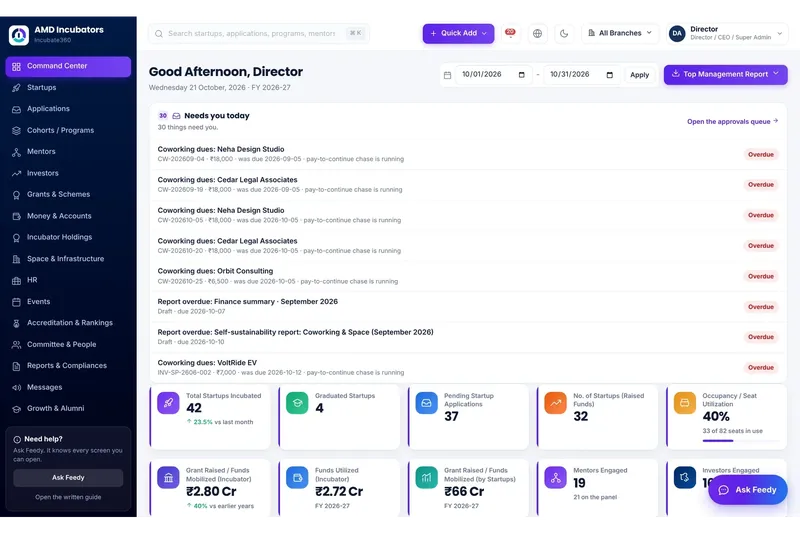
Live dashboard for owners
See your centre's progress live, any day
Your chairman, trustees and director get their own Incubate360 login. Open it on a phone or laptop to see what the centre did this week, what has been filed and what money has come in, without waiting for a report.
- Startups incubated and their progress
- Applications filed, scheme by scheme
- Grants sanctioned and instalments received
- Events run, with participation
- Mentors engaged and sessions held
- Income earned, by stream
- IIC activities, quarter by quarter
- Evidence files ready for NAAC, NBA and NIRF
- Every monthWritten progress report: what was done, what comes next, and any risks.
- Every monthReview meeting with your nodal officer.
- Every quarterLeadership review with your management and trustees.
- Every dayLive progress dashboard in Incubate360.
- Every yearAnnual impact report for your board.
How it works
From your yes to a running, funded centre

Plan
We study your campus, map the schemes you qualify for, and give you a 6-year roadmap to approve.
Set up
Your Section 8 company, policies, team, space and software, then the inauguration.
Run and fund
Student programmes, the first startups, state and MSME filings, and records for NAAC and NIRF.
Grow
Bigger national grants as your centre qualifies, more income, and a Centre of Excellence bid.
Watch how it works
A short film for your trustees and leadership: what we build, what you provide, and how grants come in year by year.
- Your first 90 days: campus study, Section 8 company, team hired
- A running centre and the first startups in Year 1
- Bigger national grants as your centre qualifies

Year 1, month by month
Every month ends with something you can see and check.
Kick-off and campus study
- Kick-off with management; nodal officer named
- Study of space, people and current activity
- Scheme eligibility map for your campus
You get: Campus Diagnostic Report and 6-year roadmap for your approval
Legal structure and policies
- Section 8 company documents prepared and filed
- Innovation and Startup, IPR and Incubation policies
- Innovation Council (IIC) set up or strengthened
You get: Policy pack and incorporation filing
Space, team and software
- Space layout and equipment plan
- Incubation Manager and two staff hired with you
- Incubate360 set up and staff trained
You get: A hired team, a space plan and live software
Open the idea pipeline
- Awareness drive for students and faculty
- Campus ideathon; pre-incubation opens
- Mentor panel formed
You get: First idea pipeline and a mentor panel
First startup cohort
- Selection committee picks the first startups
- Bootcamp: validation, business model, pitching
- State recognition and MSME Host Institute filings
You get: First cohort onboarded and state filings made
Inauguration
- Incubation centre inauguration event
- Media release and digital launch
- Half-year review with your leadership
You get: A running centre and a half-year report
MSME readiness
- Student ideas shaped for the MSME Idea Hackathon
- IPR awareness workshop
- First patent and IP filings guided
You get: Idea proposals ready for the next MSME cycle
Hackathon and industry
- Campus hackathon or startup challenge
- Industry and alumni connects
- Partnership MoUs initiated
You get: Hackathon run and partners engaged
Income engine
- Co-working and training offers launched
- Faculty development programme on innovation
- Income tracked in Incubate360
You get: First income streams open
State support claims
- Running-cost or capital claims filed where your state allows
- Recognition inspection and records check
- MSME machinery proposal once ideas are approved
You get: First state support claims filed
Demo Day and records
- Demo Day with investors and industry
- NAAC 3.2, NBA 9.5, NIRF and IIC evidence compiled
- Startup progress reviews
You get: Demo Day and accreditation-ready files
Year 1 review
- 10+ startups incubated
- Annual impact report to your board
- Year 2 grant calendar agreed
You get: Annual Impact Report and Year 2 plan
Why colleges trust us
Honest plans, real activity, proper records

You work with the founder
Dr. Mayank Raj
Founder, Incunation Global · Editor-in-Chief, StartupFeed · Editor, PeoplesFeed
Mayank founded Incunation Global and leads the incubation centre advisory himself, from the first campus study to the grant files. He is Editor-in-Chief of StartupFeed and Editor of PeoplesFeed, which keeps him close to the founders, incubators and policy changes that decide what a campus centre can achieve.
The same team runs





Independent
We are a private advisory. We never claim government authorisation and never use government logos.
No false promises
No one can guarantee a grant, and we never claim to. When a scheme is closed, we tell you.
You own everything
The Section 8 company, policies, files and team are yours. You can stop after 12 months and keep it all.
Always in the loop
A written report and a review meeting every month, a leadership review every quarter, and a live dashboard.
Real activity, proper records
We build genuine programmes and keep the evidence NAAC, NBA, NIRF and IIC look for. We never sell grades or ranks.
We live in this world
We run StartupFeed and CampusFeed and build Incubate360, so we track schemes and policy every day.
What the centre does for NAAC, NBA, NIRF and IIC
Colleges and universitiesCriterion 3: Research, Innovations and Extension. Key Indicator 3.2: Innovation Ecosystem.Incubation centre, IPR and entrepreneurship workshops, documented activity.
UG Engineering, Tier IICriterion 9.5: Start-up and Entrepreneurship Activities (5 marks).Incubation cell, regular activities and student ventures.
Innovation, 2025 frameworkPre-incubation and incubation (10%), innovation policy and IIC (10%), funding for innovation including government grants (25%).Startups incubated, IIC performance, and grants and seed funding won.
Ministry of EducationInstitution's Innovation Council rating, based on activities every quarter.Qualifying activities, run and recorded every quarter.
National policyIncubation through a Section 8 company or society. At least 1% of the budget for innovation (recommended).The structure, policies and records that show alignment.
Doing it yourself, or doing it with us
The fee
One monthly fee, everything included
You pay
Fee on request
One monthly fee for the complete package, including Incubate360. Minimum 12 months, planned for six years. After a short call, we send a fee proposal for your campus.
You can stop after 12 months and keep everything built.
What can come in
- State support where your state offers it, such as up to ₹40 L a year in UP
- Capital grants and MSME machinery support
- Income from co-working, training and services
Example: 50 co-working seats at ₹3,000 = ₹1,50,000 a month. Illustration only.
Even in a slow year, you keep
- Your own Section 8 incubation company
- Policies, SOPs and agreements
- A trained incubation team
- A working centre with startups
- Accreditation-ready records
- Applications ready for the next call
Incunation Global does
- 6-year roadmap and scheme strategy
- Section 8, DPIIT and scheme registrations
- All documents, applications and reports
- Recruitment support and staff training
- Student programmes and events
- Accreditation evidence system
- Incubate360 software and setup
Your institution provides
- Space and infrastructure for the centre
- All event costs
- A nodal officer and a management sponsor
- Salaries for the incubation team
- Timely approvals, signatures and board resolutions
- Matching contributions where a scheme needs them
- Registration and government fees
- Student and faculty time in the calendar
Do the maths: a few extra admissions a year, at your own course fee, can cover the partnership. Your fee proposal works this out for your campus. Travel and stay for visits outside Greater Noida are billed at actuals; online support is free.
Brochures
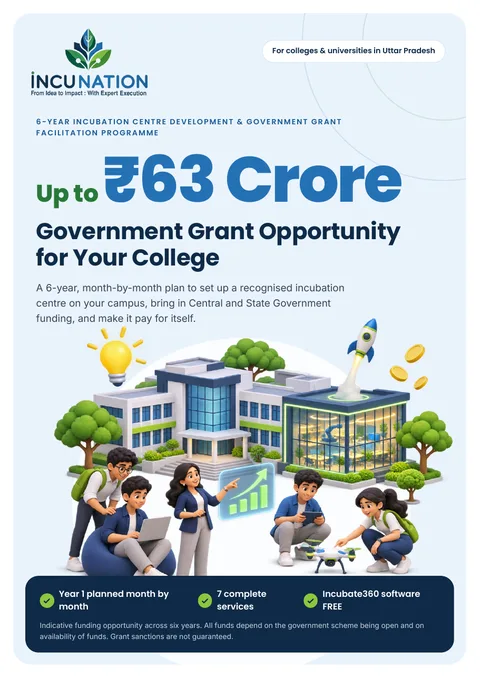
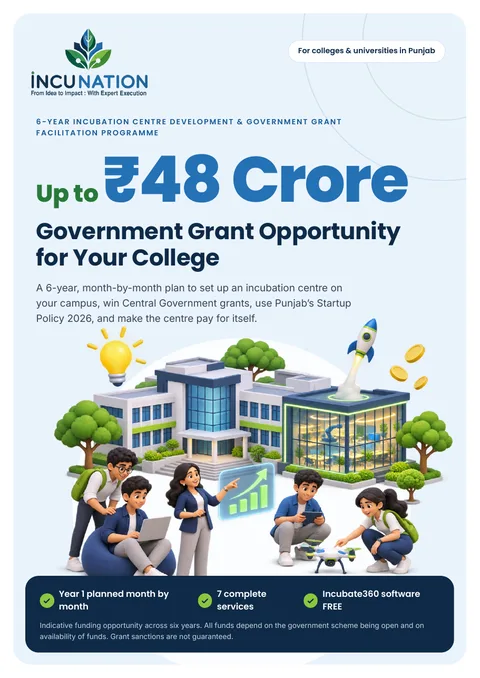
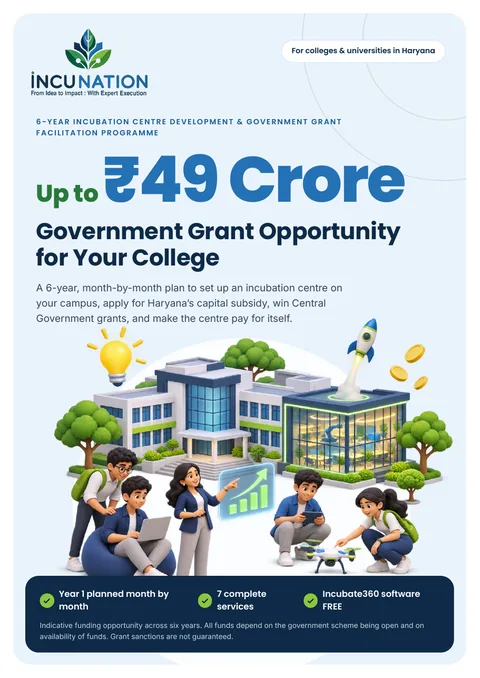
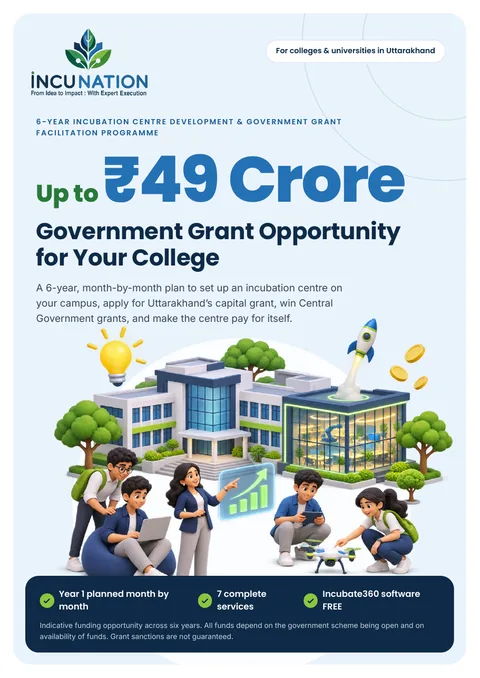
The full proposal for your state
Twenty pages each, free, no form to fill. Easy to forward to your trustees.
Questions owners ask
Frequently asked questions
Not answered here? Ask us directly. We reply within one working day.
What happens in the first 90 days?
Campus study and your 6-year roadmap in Month 1. Section 8 filing and policies in Month 2. Team hiring, the space plan and Incubate360 in Month 3.
Will this add load on our faculty?
No. We handle the planning, paperwork, applications and reporting. Your faculty mentor and teach.
Who controls the centre and its funds?
You do. Grants go to your own Section 8 company, run by your board. Every document we create is yours to keep.
How soon can grant money come in?
In UP, running support can start in Year 1 once the centre is recognised, and Haryana and Uttarakhand pay towards setup from Year 1. MSME machinery support follows two approved ideas, usually in Year 2. National grants such as NIDHI-iTBI come from Year 3, when calls open.
How much space do we need?
In UP and Haryana, recognition needs about 10,000 sq ft of ready space, and an Atal Incubation Centre also asks for 10,000 sq ft. A national Centre of Excellence later needs 50,000 sq ft. We study your space in Month 1 and plan it in phases.
Are grants guaranteed?
No one can guarantee a government grant. We maximise your chances with the right structure, documents and timing, and we tell you plainly when a scheme is closed or a call has not opened.
Are you authorised by NAAC, AIM, DST or any ministry?
No. Incunation Global is an independent private advisory. We do not claim any government authorisation, and we do not sell grades or ranks. We help you build real activity and keep proper records.
What else will we spend?
Space and infrastructure, events, team salaries, upkeep, registration charges, travel for on-site visits outside Greater Noida, and any matching share a scheme asks for.
Can we stop if it is not working?
Yes. The minimum commitment is 12 months. The roadmap is planned for six years, and everything built until then stays with you.
Do you work with universities as well as colleges?
Yes. We work with private universities, deemed universities and colleges in Uttar Pradesh, Punjab, Haryana and Uttarakhand. Some state grants are higher for universities.
What if a scheme closes or a call does not open?
The roadmap is a sequence, not a single bet. We move to the next scheme your centre qualifies for and keep the files ready for when the call opens.
Who will we work with?
Dr. Mayank Raj leads the incubation centre advisory himself, from the first campus study to the grant files, with our team for programmes, software and records.
Next step
Book a free presentation for your leadership team
On campus or online. We walk your management through the roadmap for your campus and your state, and answer every question.
- PresentationA focused session for your leadership team.
- Your roadmapThe schemes you qualify for, in the right order.
- Fee proposalOne monthly fee, sent to you in writing.
Sources for every figure on this page, last checked 20 November 2026
Central schemes
Uttar Pradesh
Haryana
Scheme names, amounts and conditions are based on published Central and State Government guidelines as of November 2026 and are indicative "up to" ceilings. Multi-year grants come in instalments as per scheme rules.